
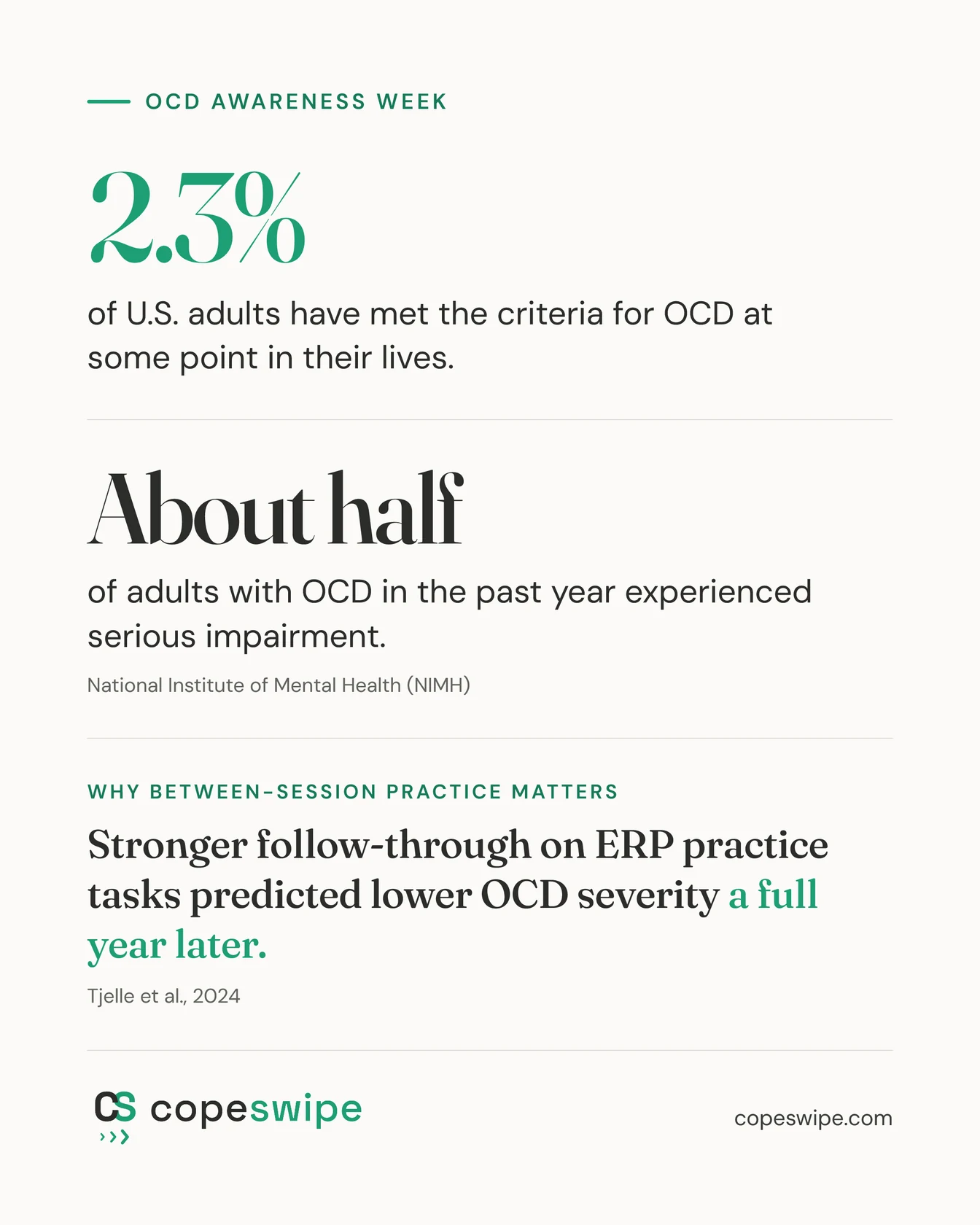
OCD Awareness Week runs October 11 to 17 (IOCDF), a yearly push to correct the idea that OCD is a personality quirk. An estimated 2.3% of U.S. adults have met the criteria for OCD at some point in their lives, and about half of adults with OCD in the past year experienced serious impairment (NIMH).
Exposure and response prevention (ERP) asks clients to face what triggers their obsessions and then choose not to perform the compulsion (IOCDF). Much of that work happens outside the therapy room, often with no one coaching clients through the hardest minutes. Parents frequently serve as exposure coaches for children, and some adults choose a trusted family member for the role, usually after that person meets with the therapist to learn how. Either way, the quality of between-session practice shapes the outcome.
Why Does ERP Depend on Between-Session Practice?
Standard ERP protocols assign daily self-directed exposures and response prevention as homework, so much of the practice happens where obsessions show up, in real life. Research links how well clients carry out this home practice, and especially how often they resist urges to ritualize, to lower OCD severity after treatment.
In a 2024 study of 163 adults with difficult-to-treat OCD who received concentrated ERP over four consecutive days, higher adherence to ERP tasks was linked with lower OCD severity after treatment and predicted lower severity a full year later, even after adjusting for other factors (Tjelle et al., 2024).
A smaller study illustrated which part of that practice matters most. In an ERP study of 37 adults, therapists rated three aspects of home practice: the share of assigned exposures attempted, the quality of the attempted exposures, and the percentage of urges to do a compulsion that the client resisted. Higher ratings on all three were linked to lower post-treatment severity, but only success resisting compulsions independently predicted outcome (Wheaton et al., 2016). For clinicians, resisted urges may be the most useful number in the home log.
What Gets in the Way of Exposure Practice at Home?
At home, clients face exposures without a clinician to coach them through peak distress, and stopping early is easy to justify. Rituals can also shift into less visible forms, such as mental reviewing or seeking reassurance, which a client may not recognize or report as compulsions.
A client with contamination fears touches the doorknob as assigned, then washes twenty minutes later "just to be safe." A client with harm obsessions finishes an imaginal exposure, then texts a partner to ask whether they seem like a dangerous person. Both look like completed homework, and both end the uncertainty the exposure was meant to leave in place.
Family members can get pulled in too, answering reassurance questions or doing checks on the client's behalf, a pattern known as family accommodation. That is one more reason a parent or partner who coaches exposures benefits from time with the therapist. For young children, family-based ERP has trial support: among 127 children ages 5 to 8, 72% were much or very much improved after 14 weeks, versus 41% with family-based relaxation training (Freeman et al., 2014).
When Do Coping Skills Become Compulsions?
A coping skill acts like a compulsion when it is used to escape, neutralize, or shorten the uncomfortable but tolerable distress an exposure is meant to produce. It then functions as a safety behavior, an action meant to prevent or minimize a feared outcome, and experts are divided on whether to allow it.
This is a genuine split in the field. One school, grounded in inhibitory learning theory, recommends eliminating safety behaviors as quickly as clients are willing (Blakey & Abramowitz, 2016), and some OCD specialists extend that caution to any coping skill introduced during treatment. Another proposes "judicious use": careful, strategic use of safety behaviors in the early or most challenging stages of treatment, which proponents argue can build a client's sense of mastery (Rachman, Radomsky, & Shafran, 2008).
The research has not settled it. A meta-analysis of 20 studies found no compelling evidence for either removing or allowing safety-seeking behavior during exposure (Meulders et al., 2016). Key studies supporting judicious use also relied on non-OCD samples, such as undergraduates in a contamination task and adults with spider fear (Rachman et al., 2011; Blakey et al., 2019).
For between-session practice, the useful question is function, not form. The same grounding exercise that helps a client ride out a panic spike at work becomes a ritual when it is used mid-exposure to make an obsession go away.
Whichever position a clinician holds, the practical step is the same: agree with the client before practice starts which skills, if any, belong in an exposure. Tools like those in our coping cards for anxiety guide are built for other moments, not for neutralizing an obsession mid-exposure.
How Can Clinicians Structure Exposure Practice Between Sessions?
Build the hierarchy with the client, name likely rituals in advance, and ask for a log of distress ratings and urges resisted, not just exposures completed. Then open every session by reviewing that log, since this is the record of what the client practiced without you.
Build the Hierarchy with the Client
Rank exposures together by expected distress, using a subjective units of distress (SUDS) rating, so the client knows where each assignment sits and why. A hierarchy the client helped design feels like their plan, not a list of instructions handed over at the end of a session.
Name the Rituals Before They Happen
For each exposure, list the specific compulsions and safety behaviors the client is likely to reach for, including mental ones like reviewing or seeking reassurance. A ritual that has been named in advance is easier to notice in the moment and easier to report honestly afterward.
Log Urges Resisted, Not Just Exposures Completed
Ask clients to record distress before, at the peak, and after each exposure, along with which compulsions they engaged in or resisted. Completion alone hides the variable most closely tied to outcome in a study of ERP adherence: how often clients resisted urges to ritualize between sessions.
Review the Log First
Whenever possible, start each session with the home log, before anything else on the agenda. Reviewing it signals that practice matters, shows where the hierarchy needs adjusting, and catches avoidance early, before a stalled week of exposures quietly becomes a stalled month of treatment.
We covered the same review habit in our post on homework adherence in depression.
Clinical Takeaways and Implementation Steps
- Treat home practice as the main event. Plan each exposure expecting many repetitions to happen outside session.
- Track resisted urges. Ask what the client did with the urge, not only whether the exposure happened.
- Name mental rituals explicitly. Reviewing, reassurance seeking, and neutralizing phrases rarely get reported unless you ask.
- Judge coping skills by function. Agree in advance which skills, if any, fit an exposure and which would undercut it.
- Review the log before anything else. Open each session with what happened at home.
The copeswipe Edge: An Exposure Plan That Goes Home with the Client
copeswipe gives clinicians a HIPAA-compliant ERP hierarchy builder with client session logging. The clinician sets each exposure, its expected distress range, and the compulsions to avoid. The client logs distress and any use of compulsions on their phone, and the clinician reviews adherence before the next session.
On the copeswipe platform, a clinician adding an exposure item chooses in vivo, imaginal, or interoceptive, sets an expected SUDS range, and lists the compulsions and safety behaviors to avoid. Those items pre-fill the client's session log as reminders, so "seeking reassurance" or "mental checking for safety" is named before the urge arrives. The fields follow the structure of ERP itself, so the plan a client takes home matches the one built in session.
During practice, the client marks peak distress and, for each listed compulsion, records whether they engaged in it fully, partially, or not at all. Each exposure also has a built-in timer, so the clinician can see how long distress took to peak and then fall to half of that peak, a benchmark many ERP clinicians track. The clinician sees a progress graph for each hierarchy item, with before, peak, and after ratings across sessions, which is enough to open a session knowing what happened at home. Clients see their progress too: after each exposure, a short note shows how much their SUDS rating dropped from peak to end. It is not activity monitoring: copeswipe does not report overall time in the app or time spent on coping skills and thought records, and clients are not scored or ranked.
The exposure plan, and every clinical judgment about it, stays with the clinician. There is no AI in any client- or clinician-facing function. Crisis resources are visible at multiple points in the app, and copeswipe is a tool for structured, clinician-assigned practice, not a crisis intervention service.
References & Further Reading
- International OCD Foundation. OCD Awareness Week. https://iocdf.org/ocdweek
- National Institute of Mental Health. Obsessive-Compulsive Disorder (OCD) statistics. https://www.nimh.nih.gov/health/statistics/obsessive-compulsive-disorder-ocd
- International OCD Foundation. Exposure and Response Prevention (ERP). https://iocdf.org/about-ocd/treatment/erp/
- Tjelle, K., Opstad, H. B., Solem, S., Kvale, G., Wheaton, M. G., Björgvinsson, T., Hansen, B., et al. (2024). Patient adherence as a predictor of acute and long-term outcomes in concentrated exposure treatment for difficult-to-treat obsessive-compulsive disorder. BMC Psychiatry, 24, 327. https://doi.org/10.1186/s12888-024-05780-6
- Freeman, J., Sapyta, J., Garcia, A., Compton, S., Khanna, M., Flessner, C., et al. (2014). Family-based treatment of early childhood obsessive-compulsive disorder: The Pediatric Obsessive-Compulsive Disorder Treatment Study for Young Children (POTS Jr), a randomized clinical trial. JAMA Psychiatry, 71(6), 689-698. https://doi.org/10.1001/jamapsychiatry.2014.170
- Wheaton, M. G., Galfalvy, H., Steinman, S. A., Wall, M. M., Foa, E. B., & Simpson, H. B. (2016). Patient adherence and treatment outcome with exposure and response prevention for OCD: Which components of adherence matter and who becomes well? Behaviour Research and Therapy, 85, 6-12. https://doi.org/10.1016/j.brat.2016.07.010
- Meulders, A., Van Daele, T., Volders, S., & Vlaeyen, J. W. S. (2016). The use of safety-seeking behavior in exposure-based treatments for fear and anxiety: Benefit or burden? A meta-analytic review. Clinical Psychology Review, 45, 144-156. https://doi.org/10.1016/j.cpr.2016.02.002
- Blakey, S. M., & Abramowitz, J. S. (2016). The effects of safety behaviors during exposure therapy for anxiety: Critical analysis from an inhibitory learning perspective. Clinical Psychology Review, 49, 1-15. https://doi.org/10.1016/j.cpr.2016.07.002
- Blakey, S. M., Abramowitz, J. S., Buchholz, J., Jessup, S., Jacoby, R., Reuman, L., & Pentel, K. (2019). A randomized controlled trial of the judicious use of safety behaviors during exposure therapy. Behaviour Research and Therapy, 112, 28-35. https://doi.org/10.1016/j.brat.2018.11.010
- Rachman, S., Radomsky, A. S., & Shafran, R. (2008). Safety behaviour: A reconsideration. Behaviour Research and Therapy, 46, 163-173. https://doi.org/10.1016/j.brat.2007.11.008
- Rachman, S., Shafran, R., Radomsky, A. S., & Zysk, E. (2011). Reducing contamination by exposure plus safety behaviour. Journal of Behavior Therapy and Experimental Psychiatry, 42(3), 397-404. https://doi.org/10.1016/j.jbtep.2011.02.010