
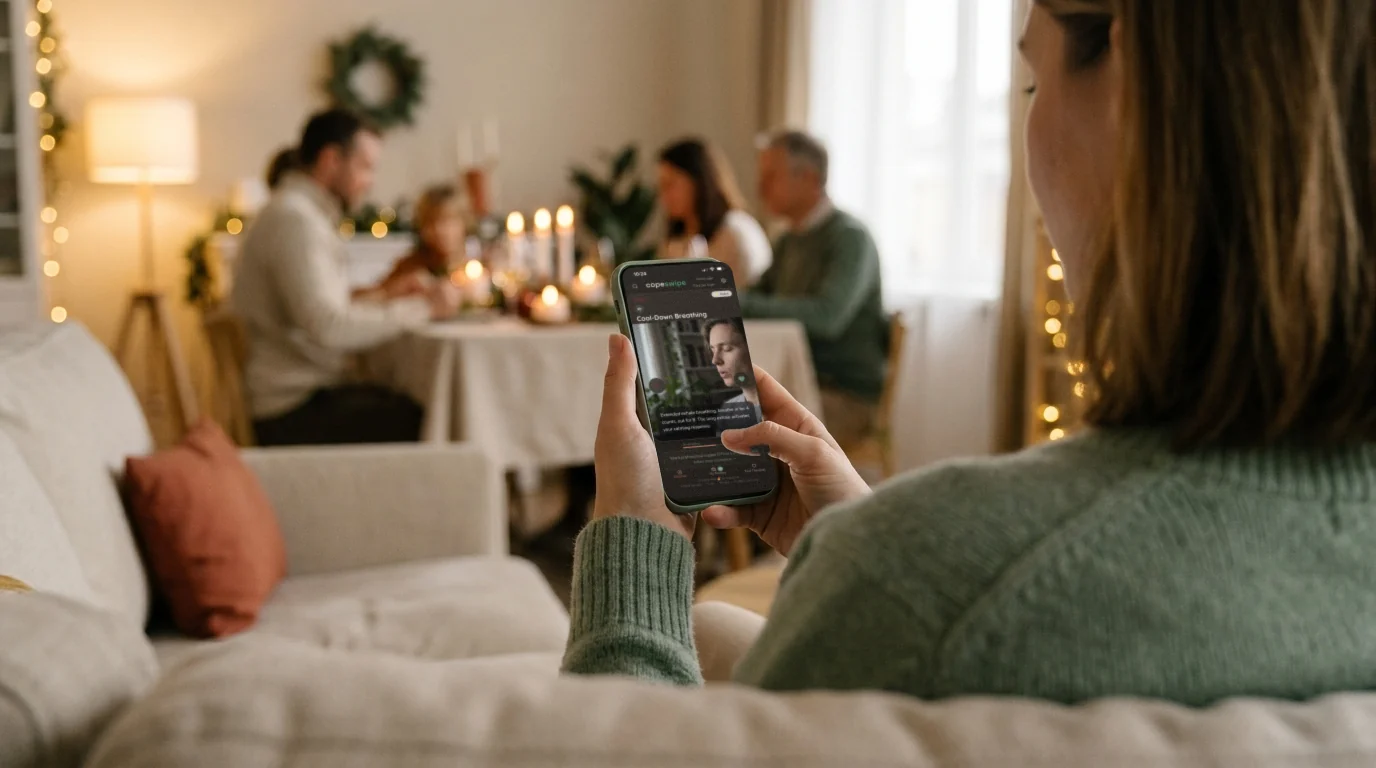
Many of us know this holiday scene by heart. A few family members flit between the kitchen and the dining room, organizing, refilling, and working hard to make sure everyone has a good time. Everyone else is on the couch, heads down, scrolling. Not talking. Not connecting.
This can't be blamed completely on holiday stress. But in a world where tensions often run high and families sometimes disagree, we now carry a new and very convenient way to escape the uncomfortable moment. And even when the phone isn't helping us avoid each other, it is often helping us avoid something else. Sometimes it's the steady hum of stress that comes with holiday logistics: the travel, the gifts, the guest list, the to-do list. Sometimes it's grief, and the heartbreak of the empty chair that makes this time of year so difficult.
For clinicians, this matters because the scroll often functions as coping: it can take the edge off fast, or at least feel like it does, which is part of why clients keep reaching for it. As the holiday season approaches, just a few weeks away, the clinical question is: how do we help our clients reach for skills they practiced in therapy in these stressful moments, rather than a feed engineered to keep them scrolling?
Why Do Clients Reach for Their Phones When Holiday Stress Rises?
Clients may reach for their phones because scrolling feels like it works in the moment. It offers instant distance from tension, grief, or a long to-do list, and that sense of relief can reinforce the behavior. Research links stress to problematic smartphone use, and experiential avoidance may help explain the connection.
The holidays raise the pressure in predictable ways. In the American Psychiatric Association's Healthy Minds Poll, fielded in early November 2025, 41% of U.S. adults said they expected more holiday stress than the year before, up from 28% in 2024 and 29% in 2023. Younger adults were the most likely to expect more stress: 49% of 18- to 34-year-olds, compared with 27% of those 65 and older.
The worries behind those numbers map onto the reasons described above. Nearly half of respondents (48%) were worried about missing someone or grief, and 46% about affording or finding gifts. About a third were worried about challenging family dynamics (32%) or loneliness (31%). In other words, holiday stress comes from the people at the table, the budget and the to-do list, and the people missing from it.
Phones show up in family conversations year-round, too. In a Pew Research Center survey published in 2024, 46% of teens said a parent is at least sometimes distracted by their phone when the teen is trying to talk to them. Only 31% of parents said the same about themselves.
What Does the Research Say About Stress and Phone Use?
Research links stress to problematic smartphone use, and experiential avoidance helps explain the connection. In a cross-sectional study of 763 college students in China, perceived stress was associated with problematic phone use, and that link was partly carried by a tendency to avoid uncomfortable thoughts, feelings, and sensations.
"Problematic smartphone use" is the research term for phone use that feels compulsive and begins to crowd out daily functioning (Zhang & Wang, 2022). Experiential avoidance is a transdiagnostic process most clinicians already know well: an unwillingness to stay in contact with unwanted internal experiences, such as thoughts, emotions, memories, and bodily sensations, along with efforts to change or escape them (Hayes et al., 1996). In Zhang and Wang's (2022) study, higher trait mindfulness weakened the path from stress to experiential avoidance.
The phone is well suited to avoidance. It is always within reach, socially acceptable almost anywhere, and able to deliver distraction almost instantly. Behaviorally, it can look like this: discomfort rises, the client reaches for the phone, the discomfort seems to recede for a moment, and that sense of relief strengthens the reach next time. Over months, the scroll can quietly become one of the client's most practiced coping responses.
Why Isn't 'Just Put the Phone Down' Enough?
Cutting back can help. In a meta-analysis of 10 randomized trials, reducing social media use led to a small drop in depressive symptoms over periods of up to three weeks. But telling clients to use their phones less targets the behavior and leaves the need in place. Remove the scroll without a replacement and the urge may simply wait for the next stressful moment. Planning what to do instead may matter: in studies of unhealthy eating habits, if-then plans that only said what not to do backfired compared with plans that named a replacement, especially when the habit was strong.
A 2026 study in Emotion by de Segovia Vicente and colleagues used experience sampling (a method that prompts participants with brief surveys throughout the day) to follow more than 1,000 adults in Belgium for two weeks. People were more likely to use their phones to express or avoid feelings when they already felt low. Yet using the phone this way was not followed by a meaningful drop in negative affect about three hours later, and using it specifically to avoid feelings was linked to a very small increase in negative affect. Avoidance was linked to more social media use.
Doomscrolling, the compulsive consumption of negative online content, is narrower than everyday scrolling, but research on it suggests how platform design can make the pattern sticky. A 2026 scoping review of 17 doomscrolling studies in Mental Health and Digital Technologies describes the behavior as habitual and compulsive, reinforced by infinite scroll (a feed with no natural stopping point) and algorithmic delivery (content selected based on what has held your attention before). The evidence is mostly cross-sectional, but it consistently ties doomscrolling to anxiety, depression, and stress. The one experimental "kindness-scrolling" intervention produced only short-term mood benefits.
Why Pair Less Scrolling With a Replacement?
A replacement keeps the cue and changes the response. Habits form when a behavior is repeated in a consistent context, so with enough repetitions, the moment that usually triggers a scroll may start to cue a practiced skill instead.
The holiday cues are not going away. The tense conversation, the overflowing group chat, the empty chair, or the third trip to the store will all arrive on schedule. Those stress cues need a destination, and substitution gives them a more positive place to land.
Timing matters, too. In Lally and colleagues' well-known habit study, the median time for a simple daily behavior to reach near-automaticity was 66 days among participants whose data fit the model, with individual estimates ranging from 18 to 254 days. Early repetitions produced the biggest gains. Starting now won't make a new response automatic by Thanksgiving, but it captures those early gains before the hardest gatherings arrive.
How Can Therapists Help Clients Swap the Scroll for a Coping Skill Between Sessions?
Treat the scroll as a cue to redirect, not a behavior to shame. Map when the client reaches for the phone, write an if-then plan that routes that moment to a specific skill, rehearse the skill before it is needed, and review what happened at the next session.
The skill itself should come from your treatment plan and theoretical orientation. What follows is about delivery: getting a skill the client already understands into the exact moment the phone usually wins.
1. Map the Client's Scroll Cues Before the Holidays Arrive
Start with a quick functional map of the client's phone use. Ask when the reach happens, where they are, who is present, and what they feel just before. Holiday cues are often predictable: a specific relative, a loaded topic, a budget conversation, or the hour after everyone leaves.
Separate the functions described earlier. Interpersonal avoidance (escaping a tense moment at the table), logistical avoidance (escaping the to-do list), and avoidance of grief (escaping the heartache of absence) may call for different skills and different plans. A week of self-monitoring before the first big gathering often surfaces patterns the client has never noticed.
2. Write the Swap as an If-Then Plan
Turn the swap into a specific if-then statement that names the cue and the replacement. Researchers call these implementation intentions. A 2025 meta-analysis of 642 tests found a small-to-medium average effect (d = 0.36) on goal attainment, with larger effects when plans used an if-then format and were rehearsed.
These plans work by making the cue easier to notice and the response more automatic. The plan should sound like the client's own life:
- "If I notice myself reaching for my phone when the conversation at dinner turns tense, then I will open my coping card and practice the skill we chose for two minutes before I rejoin."
- "If I pick up my phone to recheck a shipping update for the third time tonight, then I will run through my coping card instead."
Notice what the plan does not ask. It does not ask the client to leave the phone in another room or white-knuckle through the urge. The reach still happens; it just goes somewhere else. The replacement should have a clear stopping point, so the client returns to the room rather than disappearing into a different screen.
3. Rehearse the Skill Before It Is Needed
A skill attempted for the first time mid-argument is likely to be hard to access. Practice it in session, then in low-stakes moments at home, which makes the skill more familiar when stress is high. Habit research shows the largest gains in automaticity come from early repetitions, which makes the weeks before the first big gathering the highest-value practice window.
Ask the client to run the swap on purpose a few times a day, attached to ordinary reaches for the phone: waiting in line, a lull in the evening, the moment before opening social media. Each rehearsal strengthens the link between cue and response while stress is low, so the skill is available when stress is high. This is generalization in its most practical form: the skill moves from your office into the contexts where the client actually needs it.
4. Review What Happened, Without Judgment
Use the next session to review the swaps that happened and the ones that didn't. Treat a missed opportunity as useful data. In Lally's research, missing one opportunity did not significantly affect habit formation, so a rough holiday dinner is a reason to adjust the plan, not abandon it.
Plan for the calendar, too. Holiday weeks bring cancellations and office closures, so agree in advance on what the client will practice and how they will note it if a session falls through. Curiosity matters more than compliance here: what made the phone win in that moment, and what would make the swap easier next time?
Clinical Takeaways
- Assess the function first. Holiday scrolling can be avoidance-based coping, aimed at interpersonal tension, grief, or logistical overload.
- Plan for real pressure. In November 2025, 41% of U.S. adults anticipated more holiday stress, with missing someone or grief (48%) and affording or finding gifts (46%) leading the worries.
- Give the urge somewhere to go. Pair any cutback with a practiced replacement skill at the same cue.
- Create the swap as an if-then plan in the client's own words, naming a specific cue and a specific skill.
- Keep the replacement short. A skill with a clear end returns the client to the room instead of to another feed.
- Rehearse before the first big gathering. Early repetitions build automaticity fastest.
- Review without judgment and plan ahead for holiday schedule gaps.
The copeswipe Edge: Same Device, Same Swipe, Different Destination
copeswipe puts the clinician-assigned coping skill on the same device, behind the same swipe, where the urge to scroll already happens. Instead of a feed engineered for endless engagement, clients open a short set of skills chosen with their therapist, practice one, and return to the people around them.
Therapy is one hour a week. Real life is the other 167 hours, and the holidays pack a lot into them. We built copeswipe for exactly those hours. Clinicians assign coping cards from a library written or reviewed by licensed clinicians, set how often to practice, and add their own note, so the client's between-session tool reflects the work you're doing together. If you have been relying on handouts, here is why clients actually use digital tools.
The platform is HIPAA compliant and uses no AI in its client- or clinician-facing functions. Every card reflects a clinician's judgment, not an algorithm's guess about what will keep someone engaged. That is the point. The technology handles the structure: the skill you chose together, a tap away whenever the client picks up the phone. You handle what no tool can: noticing, attuning, and helping the client make meaning of what happened when the urge hit.
This holiday season, the phone will be in your client's hand either way. The question is what it opens.
Sources
- Adriaanse, M. A., van Oosten, J. M. F., de Ridder, D. T. D., de Wit, J. B. F., & Evers, C. (2011). Planning what not to eat: Ironic effects of implementation intentions negating unhealthy habits. Personality and Social Psychology Bulletin, 37(1), 69-81. https://doi.org/10.1177/0146167210390523
- American Psychiatric Association. (2023). Internet gaming. https://www.psychiatry.org/Patients-Families/Internet-Gaming
- American Psychiatric Association. (2025, November 18). Americans are more anxious than last year about the upcoming holidays; health care and the economy also major concerns for many [Press release]. https://www.psychiatry.org/News-room/News-Releases/Americans-More-Anxious-About-the-Holidays
- Anderson, M., Faverio, M., & Park, E. (2024, March 11). How teens and parents approach screen time. Pew Research Center. https://www.pewresearch.org/internet/2024-03-11/how-teens-and-parents-approach-screen-time/
- de Segovia Vicente, D., Van Gaeveren, K., Murphy, S., & Vanden Abeele, M. (2026). Tapping into feelings: An experience sampling study examining the dynamics of smartphone-based emotion regulation and negative affect. Emotion, 26(2), 326-339. https://doi.org/10.1037/emo0001584
- Gollwitzer, P. M., & Sheeran, P. (2006). Implementation intentions and goal achievement: A meta-analysis of effects and processes. Advances in Experimental Social Psychology, 38, 69-119. https://doi.org/10.1016/S0065-2601(06)38002-138002-1)
- Hayes, S. C., Wilson, K. G., Gifford, E. V., Follette, V. M., & Strosahl, K. (1996). Experiential avoidance and behavioral disorders: A functional dimensional approach to diagnosis and treatment. Journal of Consulting and Clinical Psychology, 64(6), 1152-1168. https://doi.org/10.1037/0022-006X.64.6.1152
- Lally, P., van Jaarsveld, C. H. M., Potts, H. W. W., & Wardle, J. (2010). How are habits formed: Modelling habit formation in the real world. European Journal of Social Psychology, 40, 998-1009. https://doi.org/10.1002/ejsp.674
- May, W., Malouff, J. M., & Meynadier, J. (2025). Reducing social media use decreases depression symptoms: A meta-analysis of randomised controlled trials. European Journal of Investigation in Health, Psychology and Education, 15(11), 222. https://doi.org/10.3390/ejihpe15110222
- Sharpe, A., Tyndall, I., Poulus, D., Obine, E., & Sharpe, B. T. (2026). The influence of doomscrolling on mental health: A scoping review. Mental Health and Digital Technologies, 3(3), 290-342. https://doi.org/10.1108/MHDT-10-2025-0068
- Sheeran, P., Listrom, O., & Gollwitzer, P. M. (2025). The when and how of planning: Meta-analysis of the scope and components of implementation intentions in 642 tests. European Review of Social Psychology, 36(1), 162-194. https://doi.org/10.1080/10463283.2024.2334563
- Singh, B., Murphy, A., Maher, C., & Smith, A. E. (2024). Time to form a habit: A systematic review and meta-analysis of health behaviour habit formation and its determinants. Healthcare, 12(23), 2488. https://doi.org/10.3390/healthcare12232488
- Zhang, J., & Wang, E. (2022). Indulging in smartphones in times of stress: A moderated mediation model of experiential avoidance and trait mindfulness. Behavioral Sciences, 12(12), 485. https://doi.org/10.3390/bs12120485