
Every September, the mental health field marks Suicide Prevention Awareness Month with campaigns and reminders to check in on the people around us. For clinicians, there is a very nuanced process at play in the therapy room: deciding whether, when, and how often to ask a client directly about suicidal thoughts. Some may still hesitate, harboring worries that naming the unspeakable might make it more likely. The evidence says otherwise. In 2024, 48,824 Americans died by suicide, and suicide has now replaced COVID-19 as the tenth leading cause of death nationally (CDC/NCHS, 2026).
Does Asking About Suicide Actually Increase the Risk?
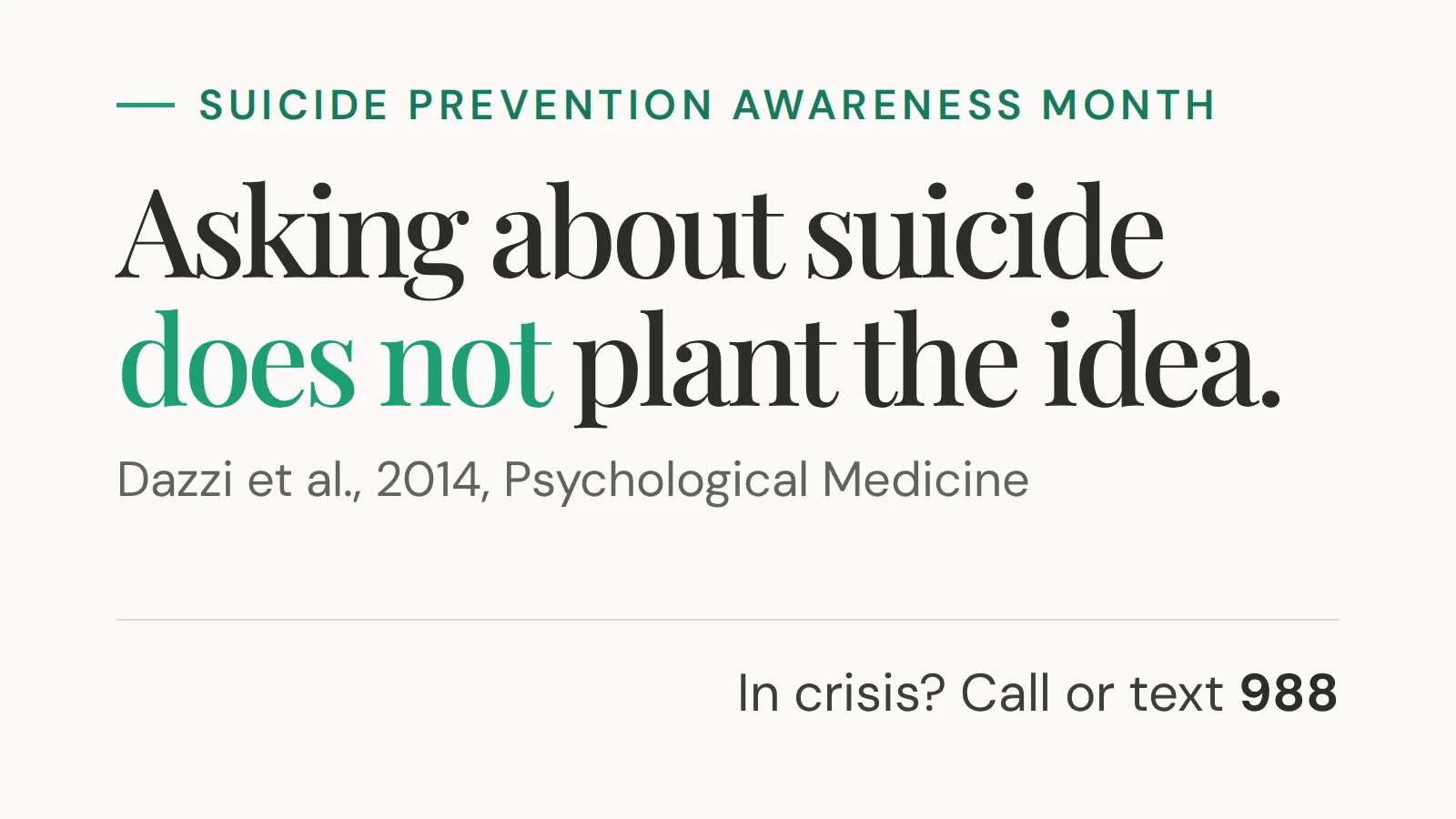
No. Every controlled study on the question has failed to find a statistically significant increase in suicidal ideation after someone is asked about it directly. A 2014 review out of King's College London found the opposite in several cases: a measurable drop in distress after the conversation (Dazzi et al., 2014).
The "planting a seed" fear has deep roots. However, Dazzi and colleagues tested that assumption directly, reviewing published research across adult and adolescent, general and at-risk populations. None showed a statistically significant increase in suicidal ideation among people asked directly. Several recorded the reverse: relief, and reduced ideation at follow-up.
The deeper point is that the thought did not originate with your question. Suicide researcher Dr. Stacey Freedenthal has a memorable way of putting this: where we may worry about planting a seed, "a large tree has already grown" (Freedenthal, 2013). People learn about suicide long before anyone in a therapy room asks about it. Your question does not introduce the idea. It finds out whether it has taken root and opens a door to understand and interrupt what is feeding it.
None of this suggests superficial, mechanical assessment. Together, directness and warmth create enough safety for someone to answer honestly. "Are you having thoughts of suicide?" asked with genuine attention lands differently than the same words asked as a box to check.
Why Isn't Suicidality a Single, Fixed State?
Suicidality is not one universal experience. Some in the field describe it as a spectrum spanning passive ideation, active planning, impulsive urges, chronic patterns, and the slow self-erosion of ongoing self-harm, and caution that people do not move through it in a predictable, linear order.
Psychotherapist Dr. Adele McDowell, author of Making Peace with Suicide, frames this as a suicide spectrum, a concept I encountered through Katherine Morgan Schafler's The Perfectionist's Guide to Losing Control (2023). McDowell separates passive suicidality (an indifference toward death rather than a wish for it) from active thinking (working out a specific plan), then splits "thinking and doing" into planned and impulsive presentations. The latter, impulsive form, is a sudden, situational urge she notes is more common among teens and young adults. She also names a chronic pattern of ongoing ideation or repeated attempts. Finally, she describes slow suicide: a lifetime of self-harm that steadily erodes health and stability, without ever producing one acute crisis moment.
She cautions that suicide does not reliably progress step by step through these categories. A client can move between them in any order or hold a chronic pattern for years without escalating. This is the same conclusion the peer-reviewed literature reaches in more clinical language, describing suicidal ideation as a continuum from passive thinking through active planning to behavior, not a set of discrete stages. A spectrum this varied cannot be captured by a single label, and it certainly cannot be captured in one discrete question.
Why Doesn't a Single Risk Assessment Cover You?
Suicide risk is not a fixed trait. It moves within hours or days depending on stressors, sleep, substance use, and life events. That is why the Joint Commission's National Patient Safety Goal 15.01.01 requires an evidence-based process for assessment and reassessment, not only a screen at intake.
A risk assessment from three months or even three sessions ago tells you little about the client in front of you today. Clinicians are trained to recognize that a sudden lift in mood after entrenched hopelessness can signal relief that a plan has been made, not evidence that risk has passed.
The data on repeated contact backs this up. In the ED-SAFE trial, patients who received universal screening, safety planning guidance, and periodic follow-up phone calls after an emergency department visit made 30% fewer total suicide attempts over 52 weeks of follow-up compared with usual care (NIMH, 2017). What worked was not a better one-time screen; it was sustained contact across time.
This is fundamentally a continuity problem, sitting on the same continuum as every other piece of between-session care. Skills generalize through repetition, not a single strong session; risk assessment works the same way. A safety plan drafted once at intake and never revisited is a snapshot, not a living document.
Why Isn't AI Ready to Sit With Someone in Crisis?
Large language models are pattern-matching systems generating statistically likely text, not licensed clinicians running a structured risk protocol. Independent 2025 research found that popular AI chatbots respond inconsistently to suicide-related questions at moderate risk levels, and nearly half of tested commercial apps failed entirely to redirect a simulated user in crisis toward emergency services.
A RAND-led study in Psychiatric Services tested three widely used chatbots (ChatGPT, Claude, and Gemini) against 30 questions spanning the suicide-risk spectrum. All three avoided direct answers to the very highest-risk questions, but responses at intermediate risk levels were inconsistent, and the researchers flagged the proclivity of two of the three to give direct responses to lethality-related questions (RAND, 2025). That echoes the spectrum above: risk does not sort into two buckets, and a system built to output one response per message struggles most with the varied territory in between.
A separate study in Scientific Reports tested 29 commercial mental health chatbot apps against simulated crises built on the Columbia-Suicide Severity Rating Scale. None met the study's criteria for an adequate response, and 48% failed entirely to redirect the user toward emergency services (Pichowicz et al., 2025). The APA's November 2025 health advisory reaches a similar conclusion: these tools should not replace a qualified provider, and clinicians should proactively ask clients whether they are using them.
Several wrongful-death lawsuits filed against major AI companies in 2024 and 2025 allege that chatbots continued open-ended conversation with users expressing suicidal ideation instead of escalating to crisis resources, and some claims have been allowed to proceed. A model has no license, no duty to warn, and no pathway to alert a human; it can only continue the conversation. A clinician can bring in real help, especially in the intermediate gray areas.
None of this makes technology the enemy of good care; it draws a clear line around what belongs on which side of it. Algorithmic tools suit the administrative weight of care, freeing clinical attention for what requires a license, a relationship, and judgment.
The copeswipe Edge: Built Clinician-in-the-Loop, on Purpose
copeswipe was designed without AI anywhere in its client- or clinician-facing functions. The targeted coping skills a client receives are chosen and assigned by their treating clinician, crisis resources are visible from multiple points in the app, and the platform is explicit that it is not a crisis intervention tool.
The system that keeps talking instead of escalating is exactly what we built copeswipe to avoid. No algorithm decides what a client practices or how to respond to signs of acute distress. That judgment stays with the licensed clinician who knows the client's history, a part of this work that cannot be automated without losing the accountability that makes it safe.
Crisis resources are clearly visible at multiple touchpoints of the user interface. The platform says plainly what it is and is not: a tool for structured, clinician-assigned practice between sessions, not a monitored crisis line or a direct line to the assigning clinician.
By handling the structural delivery of between-session practice, the platform frees clinicians' limited hours with clients for what no product can do: asking the direct question with real care and knowing when to ask it again.
Clinical Takeaways and Implementation Steps
- Ask directly, every time it is clinically warranted. Use plain language ("Are you having thoughts of suicide?") rather than euphemism.
- Reassess at every relevant encounter, not only at intake: after a disclosure, a major stressor, or an unexplained lift in mood.
- Think in spectrum terms, not yes or no. Note whether the presentation is passive, active, chronic, or self-erosive, since each implies a different response.
- Ask clients about their AI chatbot use as part of intake and ongoing check-ins, per the APA's November 2025 advisory.
- Keep crisis resources visible before they are needed. Confirm the 988 Lifeline is somewhere a client would actually find it mid-crisis.
- Let technology carry structural weight, not clinical judgment. Reserve the risk conversation for a trained human.
SAMHSA's 2026 theme is "Stronger Together: Connect. Support. Prevent," and the connection part is not abstract: since 988 launched in 2022, contact volume has passed 23 million (Pew Charitable Trusts, 2026), and a 2026 JAMA research letter tied its rollout to an 11% reduction in suicide deaths among adolescents and young adults versus projected trends. For clinicians, the theme is a job description: connection happens in the direct question, support happens in the follow-up, and prevention happens in the structures built to hold both across an entire course of care.
References & Further Reading
- SAMHSA. (2026). Suicide Prevention Awareness Month Digital Toolkit. https://www.samhsa.gov/about/digital-toolkits/suicide-prevention-month
- Dazzi, T., Gribble, R., Wessely, S., & Fear, N. T. (2014). Does asking about suicide and related behaviours induce suicidal ideation? What is the evidence? Psychological Medicine, 44(16), 3361-3363. https://www.cambridge.org/core/journals/psychological-medicine/article/does-asking-about-suicide-and-related-behaviours-induce-suicidal-ideation-what-is-the-evidence/FCAEE9E5BC840D76CF10AEBECD921AC9
- Schafler, K. M. (2023). The Perfectionist's Guide to Losing Control: A Path to Peace and Power. Portfolio/Penguin. (Features Dr. Adele McDowell's suicide spectrum framework.) https://www.amazon.com/Perfectionists-Guide-Losing-Control-Peace/dp/059332952X
- McDowell, A. R. Making Peace with Suicide: A Book of Hope, Understanding, and Comfort. https://makingpeacewithsuicide.com/about-the-author/
- CDC/National Center for Health Statistics. (2026). Mortality in the United States, 2024. Data Brief No. 548. https://www.cdc.gov/nchs/data/databriefs/db548.pdf
- The Joint Commission. National Patient Safety Goal 15.01.01: Reduce the Risk for Suicide (updated December 2025). https://digitalassets.jointcommission.org/api/public/content/459bbe2be1ab4e5082b8a8d49d0c94e0?v=69255bb9
- National Institute of Mental Health. (2017). Emergency Departments Could Play Significant Role in Reducing Suicide Attempts. https://www.nimh.nih.gov/news/science-updates/2017/emergency-departments-could-play-significant-role-in-reducing-suicide-attempts
- RAND Corporation. (2025). AI Chatbots Inconsistent in Answering Questions About Suicide; Refinement Needed to Improve Performance. https://www.rand.org/news/press/2025/08/ai-chatbots-inconsistent-in-answering-questions-about.html
- Pichowicz et al. (2025), as reviewed in Are artificial intelligence chatbots safe for suicide risk assessment? A narratively synthesized review of current evidence, Global Mental Health. https://pmc.ncbi.nlm.nih.gov/articles/PMC13373273/
- American Psychological Association. (2025). Health Advisory on the Use of Generative AI Chatbots and Wellness Applications for Mental Health. https://www.apa.org/topics/artificial-intelligence-machine-learning/health-advisory-ai-chatbots-wellness-apps-mental-health.pdf
- The Pew Charitable Trusts. (2026). 4 Years Later, 988 Suicide and Crisis Lifeline Shows Successes and Opportunities for Improvement. https://www.pew.org/en/research-and-analysis/articles/2026/07/24/4-years-later-988-suicide-and-crisis-lifeline-shows-successes-and-opportunities-for-improvement
- Federal Communications Commission. (2026). Mental Health Awareness Month: 988 Is Here to Help. https://www.fcc.gov/news-events/blog/2026/05/15/mental-health-awareness-month-988-here-help